There is something about September that makes me want to do ALL the apple activities.
Maybe it’s the first cooler mornings, apple picking, or the fact that my kids suddenly think apples are much more exciting when we bring them home in a giant bag from the orchard.
Either way, an apple theme is such an easy one to use with preschoolers.
And you definitely don’t have to turn your house into a preschool classroom to make it educational.
Some of the best apple activities for preschoolers are incredibly simple, cutting open a real apple, counting the seeds, painting with apple halves, or seeing which apples sink and which ones float.
I’ve put together 25 of my favorite ideas below, including preschool apple crafts, sensory activities, science experiments, math games, literacy activities, and plenty of fine motor practice.
Most of them use things you probably already have at home or can pick up inexpensively.
And if you need even more easy ways to keep little ones busy, check out my200 screen-free activities for kids for plenty of ideas you can use all year long.
So grab a bag of apples and let’s get started!
This site may contain affiliate links to products. I may receive a small commission (at no extra cost to you) for purchases made through these links. This helps me to pay for my website hosting and other blog-related expenses. Thank you for supporting this blog.
Why Apples Are Perfect for Preschool Learning
I love themes that make it easy to sneak a little learning into something kids already find fun.
Apples are perfect for that.
Preschoolers can sort them by color, count them, cut them open, examine the seeds, paint with them, taste different varieties, and even use them for simple science experiments.
One apple can turn into a math activity, science lesson, sensory experience, and art project without your child ever feeling like they’re doing “school.”
These activities can help preschool-age children practice:
Fine motor skills
Cutting and scissor skills
Number recognition and counting
Letter recognition
Color recognition
Pattern making
Hand-eye coordination
Early science skills
Problem solving
Vocabulary
Creative thinking
They’re also easy to adapt for 3 year olds, 4 year olds, 5 year olds, kindergarten students, homeschool lessons, daycare activities, or an apple-themed preschool classroom.
25 Apple Activities for Preschoolers
Ready for some apple-themed fun? These preschool apple activities combine learning, creativity, science, and hands-on play in simple ways young children will enjoy. Pick a few favorites or use them throughout your apple theme this fall.
1. Apple Volcano Experiment
Let’s start with one that is pretty much guaranteed to get preschoolers excited.
Turn a real apple into a mini volcano!
Cut out the core from the top of an apple, but don’t cut all the way through the bottom.
The fizzy “lava” will bubble right out of the apple.
You can even try the experiment with different-sized apples and ask your child which one they think will make the biggest eruption.
You’ll need: An apple, baking soda, vinegar, food coloring, a spoon, and a tray.
Learning: Simple chemical reactions, predicting, observing, and cause and effect.
2. Apple Seed Counting Mats
Don’t throw those apple seeds away!
Cut open an apple and let your preschooler remove the seeds with their fingers or a pair of kid-safe tweezers.
Write the numbers 1 through 10 on individual pieces of paper or use printable apple counting mats.
Have your child place the correct number of seeds onto each apple.
No seeds left?
Black beans, buttons, pom-poms, or playdough balls work just as well.
For younger preschoolers, start with numbers 1 through 5. If your child is working on numbers right now, I also have these free preschool number tracing worksheets 1–10 that are great for a little extra practice.
You’ll need: Apple seeds or small counters and number cards.
Learning: Number recognition, one-to-one correspondence, counting, and fine motor skills.
3. Apple Taste Test and Graph
This is one of my favorite apple activities because you get snack time and learning time in one.
Choose three or four different apple varieties.
Try using a red, yellow, and green apple so preschoolers can easily tell them apart.
Cut each apple into small slices and let everyone taste them.
Talk about how each one tastes.
Is it sweet?
Sour?
Crunchy?
Juicy?
Then have each child vote for their favorite.
Create a simple graph using apple pictures, stickers, or colored blocks.
When you’re finished, count the votes together and figure out which apple won.
You’ll need: Several varieties of apples, paper, crayons, or stickers.
Learning: Graphing, counting, comparing, descriptive vocabulary, and healthy eating.
4. Apple Pom-Pom Color Sort
Draw three large apples on cardboard or paper and color them red, yellow, and green.
Put red, yellow, and green pom-poms into a bowl.
Now give your child tongs, tweezers, or a clothespin and have them move each “apple” onto the matching colored tree or apple.
It sounds ridiculously simple, but using the tongs makes this a great apple fine motor activity for preschoolers.
For older children, add numbers to the apples and ask them to place a specific number of pom-poms on each one.
You’ll need: Pom-poms, cardboard, markers, and kid-safe tongs.
Learning: Color recognition, sorting, counting, and fine motor skills.
5. Apple Stamping Craft
You can’t have an apple theme without doing apple stamping at least once.
Cut an apple in half and pat the cut side dry with a paper towel.
Pour red, green, and yellow washable paint onto paper plates.
Let your child dip the apple halves into the paint and stamp them onto white paper.
Once the prints dry, add brown stems and green paper leaves.
You could also use the prints to make apple trees, homemade wrapping paper, fall cards, or an apple garland.
And don’t worry about getting perfect apple prints.
This is one of those process art activities where experimenting is half the fun.
You’ll need: Apples, washable paint, paper, a brown marker, and green construction paper.
Learning: Creative expression, color recognition, hand-eye coordination, and sensory exploration.
6. Apple Tree Playdough Counting
Make a simple apple tree using brown and green playdough.
Then roll red playdough into tiny balls to create apples.
Give your child a number card and ask them to put that many apples onto the tree.
“Can you make 4 apples?”
“Now can you make 7?”
Rolling those tiny playdough apples is fantastic for strengthening little hands and fingers.
You can also make yellow and green apples and practice creating patterns.
Red, green, red, green…
What comes next?
You’ll need: Red, green, brown, and optional yellow playdough plus number cards.
Learning: Counting, number recognition, pattern making, and fine motor skills.
7. What's Inside an Apple? Investigation
Before you start another apple craft, grab a real apple and investigate it.
Ask your child what they think is inside before cutting it open.
Then slice the apple in half through the middle.
Look closely at the skin, flesh, core, stem, and seeds.
Count the seeds together.
You can even use a magnifying glass to examine everything more closely.
Older preschoolers can draw what they see or create a simple diagram showing the different parts of an apple.
This is such an easy way to introduce early science without needing an elaborate experiment.
You’ll need: An apple, a knife for adult use, paper, crayons, and an optional magnifying glass.
Learning: Apple parts, observation, vocabulary, counting, and early science.
8. Apple Sink or Float Experiment
Will an apple sink or float?
Ask your child to make a prediction before putting an apple into a large bowl of water.
Then test it.
Try a red apple, green apple, and yellow apple.
What about an apple slice?
A seed?
The stem?
You can also gather other fall items such as an acorn, leaf, small pumpkin, pinecone, and stick and predict whether each object will sink or float.
Make two piles, “sink” and “float,” before testing everything.
You’ll need: A large container of water, apples, and other fall objects.
Learning: Predictions, observation, buoyancy, sorting, and early STEM skills.
9. Apple Sticker Number Match
Draw several apples on a large sheet of paper and write a number inside each one.
Their job is to put the correct number of “apples” inside each shape.
For example, an apple labeled 5 gets five stickers.
Those little stickers are surprisingly good fine motor practice because kids have to peel, pinch, and carefully position each one.
You’ll need: Paper, a marker, and small dot stickers.
Learning: Counting, number recognition, hand-eye coordination, and fine motor skills.
10. Apple Lacing Cards
Cut large apple shapes from sturdy cardboard.
Punch holes around the outside edge.
Tie yarn or a shoelace through one hole and let your preschooler lace around the apple.
If your child is just learning, don’t worry about creating a particular stitch.
Simply getting the string through one hole and back through another is excellent practice.
Older preschoolers can try following a pattern around the entire apple.
You’ll need: Cardboard, a hole punch, yarn or shoelaces, scissors, and markers.
Learning: Fine motor skills, hand-eye coordination, concentration, and pre-writing skills.
And if your preschooler needs a little more pencil control practice, my free shape tracing worksheets are another easy activity to add to your learning time.
11. Apple Rescue Fine Motor Game
This one takes about two minutes to set up.
Place several plastic apples, apple erasers, red pom-poms, or balls into a muffin tin.
Stretch rubber bands across the top in different directions.
Now tell your child that all the apples are trapped!
They have to reach through the rubber bands and rescue each one using their fingers or tongs.
It is a simple little game, but preschoolers LOVE anything that feels like a challenge.
You’ll need: Muffin tin, rubber bands, small apple-themed objects or pom-poms, and optional tongs.
Learning: Problem-solving, hand strength, coordination, and fine motor skills.
12. Apple Letter Hunt
Hide foam letters, magnetic letters, or paper letters inside a bin filled with red and green pom-poms, shredded paper, or another sensory-bin filler.
Let your child search for the letters.
For younger preschoolers, focus on the letters in the word APPLE.
Older preschoolers can match uppercase and lowercase letters or find the letters in their own name.
You can also place an alphabet sheet beside the bin and have your child cover each letter as they find it. If your child is starting to practice writing letters too, you can pair this activity with my free letter tracing worksheets.
You’ll need: Sensory bin filler, alphabet letters, and an optional alphabet printable.
Learning: Letter recognition, alphabet skills, sensory exploration, and fine motor development.
13. Build an Apple Tree with Recyclables
Save a cardboard tube from a paper towel roll and turn it into an apple tree.
Cut a tree canopy from recycled cardboard and paint or color it green.
Attach it to the tube.
Now add “apples” using red buttons, pom-poms, tissue paper balls, bottle caps, or fingerprints.
I especially like this one because there’s no single way the finished tree needs to look.
You’ll need: Cardboard tube, recycled cardboard, glue, paint or markers, and red craft materials.
Learning: Creative play, fine motor skills, recycling, and imaginative thinking.
14. Apple Pattern Sticks
Create simple apple patterns using red, green, and yellow pom-poms.
Start with something easy:
Red – Green – Red – Green
Then try:
Red – Red – Yellow – Red – Red – Yellow
Have your child finish the pattern.
You can glue the pom-poms onto craft sticks to create reusable pattern cards or simply arrange them on the table.
You’ll need: Red, yellow, and green pom-poms and optional craft sticks.
Learning: Pattern recognition, sequencing, colors, and early math.
15. Apple Tree Fingerprint Painting
Draw or paint a simple brown tree trunk with branches.
Let your child dip one finger into red paint and add tiny fingerprint apples all over the tree.
Add yellow and green apples too if you want an entire orchard of different varieties.
You can also turn this into a counting activity by asking your child to make exactly 10 apples.
You’ll need: Paper, a brown marker or paint, and washable finger paint.
Learning: Fine motor control, counting, creative expression, and sensory play.
16. Apple Transfer Water Play
Fill one large container with water and add several small plastic apples or red and green floating balls.
Put an empty container beside it.
Give your child a slotted spoon, ladle, tongs, or small strainer and challenge them to transfer all the apples from one container to the other.
You can make it harder by asking them to sort red and green apples into separate bowls.
Put a towel underneath everything, and you have an easy sensory activity that can keep little hands busy for quite a while.
You’ll need: Two containers, water, plastic apples or floating balls, spoon, ladle, strainer, or tongs.
Learning: Hand-eye coordination, practical life skills, sorting, and fine motor control.
17. Apple Picking Number Game
Turn your living room or classroom into an apple orchard.
Make paper apples and tape them around the room at child height.
Write a number on each apple.
Call out a number and let your child “pick” the correct apple.
For an extra challenge, call out a quantity instead.
“Can you pick the apple that shows how many fingers I’m holding up?”
This gets kids moving and makes number recognition much more fun than sitting at a table.
You’ll need: Paper apples, a marker, and tape.
Learning: Number recognition, counting, gross motor skills, and listening.
18. Apple Balance STEM Challenge
Can you build a tower using apples?
Give your child several apples and see how many they can stack.
It’s harder than it looks!
Then introduce other materials such as cardboard squares, craft sticks, or paper cups.
Can they build a structure that holds three apples?
Four?
Which design works best?
This is a fantastic open-ended STEM activity for preschoolers because there’s no single correct answer.
You’ll need: Apples plus cardboard, paper cups, blocks, or craft sticks.
Learning: Engineering, balance, problem-solving, persistence, and creative thinking.
19. Apple Cutting Practice
Draw several large apple shapes on red, yellow, and green construction paper.
Add different cutting lines through the middle of each apple.
Start with straight lines for younger children.
Then try wavy, zigzag, or curved lines.
Have your child cut along the line using preschool scissors and then match the two apple halves back together like a puzzle.
You’ll need: Construction paper, a marker, and child-safe scissors.
Learning: Scissor practice, cutting skills, matching, and visual perception.
Fill a sensory bin with materials that remind you of an apple orchard.
You could use:
Dried oats
Red and green pom-poms
Cinnamon sticks
Artificial leaves
Small baskets
Wooden scoops
Tongs
Plastic apples
Number cards
Let younger children scoop, pour, sort, and explore freely.
For older preschoolers, hide number or letter cards inside the bin and turn it into a learning game.
Learning: Sensory exploration, imaginative play, fine motor development, sorting, and early math or literacy.
Important: Always supervise sensory play closely, especially when using small objects.
21. Apple Life Cycle Wheel
Teach kids how an apple gets from a tiny seed to the fruit they eat.
Create a simple apple life cycle showing:
Seed → Sprout → Tree → Blossom → Apple
Draw or print each stage and arrange them in order.
You can turn the pictures into a wheel using two paper plates and a brass fastener, or simply have your child place the cards in the correct sequence.
Afterward, cut open a real apple and find the seeds that could start the whole cycle again.
You’ll need: Paper, crayons, scissors, a brass fastener, and an optional real apple.
Learning: Sequencing, plant life cycles, science vocabulary, and nature.
22. Apple Name Craft
Write your child’s name on individual paper apples, putting one letter on each apple.
Mix them up.
Can your child put the apples in the correct order to spell their name?
Once they do, glue the apples onto a paper tree.
For children who already recognize their names easily, try simple fall words such as:
APPLE
RED
TREE
SEED
FALL
You’ll need: Construction paper, marker, scissors, and glue.
Learning: Name recognition, letter recognition, spelling, and sequencing.
23. Bobbing for Apples with Tongs
This is our preschool-friendly version of bobbing for apples; no faces need to go anywhere near the water.
Put small apples into a container of water.
Give your child large kid-safe tongs and see if they can grab an apple and move it into a basket.
It is much harder than grabbing a pom-pom!
If the real apples are too big for your tongs, use floating toy apples or red plastic balls.
You can even turn it into a color sorting game with red, green, and yellow objects.
You’ll need: A container, water, apples or floating balls, tongs, and a basket.
Learning: Grip strength, coordination, concentration, and gross/fine motor control.
24. Apple Color Mixing in a Bag
Here’s a good option when you want to paint but don’t necessarily want paint everywhere.
Add red and yellow washable paint to a zip-top bag.
Seal it REALLY well.
I like to add tape around the top too.
Let your preschooler squish and mix the colors through the bag.
What happens?
Try other apple-inspired combinations.
Yellow + a tiny amount of green.
Red + white.
Green + yellow.
You can draw an apple outline on the outside of the bag to turn it into a simple no-mess apple painting activity.
You’ll need: Zip-top bag, washable paint, tape, and marker.
Learning: Color mixing, sensory play, prediction, and cause and effect.
25. Apple Orchard Obstacle Course
Finish your apple theme with an activity that gets everybody moving.
Create a pretend apple orchard obstacle course indoors or outside.
Kids might have to:
Crawl under a “tree.”
Jump over three “apple baskets.”
Balance an apple or red ball on a spoon.
Pick five paper apples from a wall.
Carry them across the room.
Toss the apples into a basket.
You can make the course as easy or challenging as you want.
And if your preschooler has been sitting for crafts and learning activities all morning, this is a great way to work on those gross motor skills.
You’ll need: Baskets, paper apples or balls, spoons, pillows, cones, and whatever else you have around the house.
Learning: Balance, coordination, counting, following directions, and gross motor development.
Easy Apple Activities for 3-Year-Olds
If you’re doing these activities with a younger preschooler, keep things simple.
Three-year-olds don’t need complicated instructions or a perfect finished craft.
Some of the best choices from this list are:
Apple stamping
Fingerprint apple trees
Apple sensory bins
Apple water transfer
Pom-pom color sorting
No-mess color mixing
Apple taste testing
At this age, focus more on exploring, touching, moving, and talking about what they’re doing.
Apple Activities for 4- and 5-Year-Olds
Older preschoolers are usually ready for activities with a little more structure.
Try the:
Apple volcano
Apple life cycle
Seed counting activity
Apple graphing activity
Apple lacing cards
Apple letter hunt
Apple cutting practice
Pattern activities
Apple STEM challenge
If your child is getting closer to kindergarten, you can also check out my kindergarten readiness checklist to see which skills they’re already working on and what you might want to practice next.
You can also start asking more questions.
“What do you think will happen?”
“How could we make this tower stronger?”
“Which apple has more seeds?”
“Why do you think the apple floats?”
You don’t necessarily need to know every answer.
Letting kids make predictions and come up with their own ideas is part of the learning.
Want Even More Fall Learning Activities?
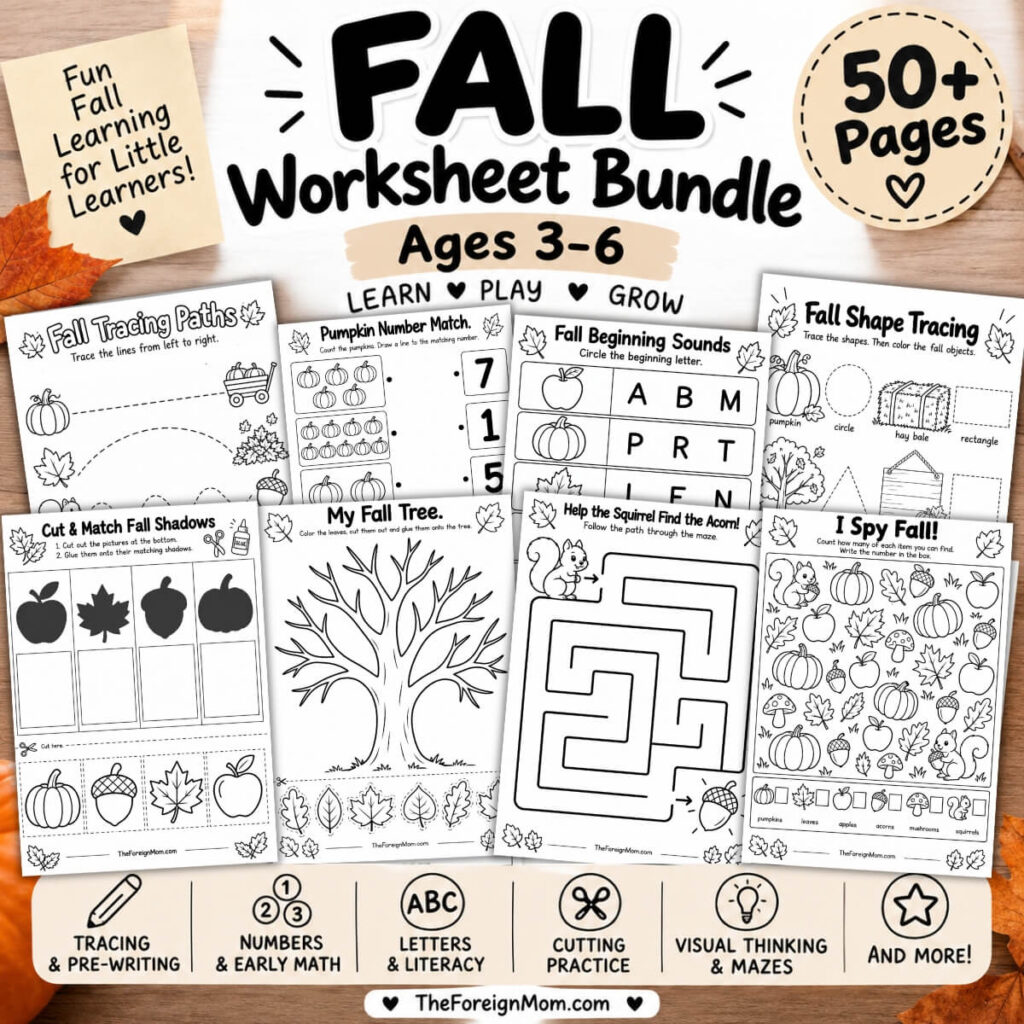
If your preschooler is ready for a little more pencil-and-paper practice, my Fall Worksheet Bundle for Preschool & Kindergarten is an easy way to keep the fall learning going.
It includes 55 printable pages for ages 3–6 with tracing, numbers and early math, alphabet practice, cutting activities, matching, patterns, mazes, fine motor practice, and more.
I designed the activities so you can simply print a few pages whenever you need a quiet learning activity for home, preschool, or homeschool.
You definitely don’t need to do all 25 activities at once.
If you’re planning an apple theme preschool week, I’d choose one activity from a different learning area each day.
For example:
Monday: Cut open an apple and learn about its parts.
Tuesday: Make apple stamps.
Wednesday: Do the apple volcano experiment.
Thursday: Have an apple taste test and graph the results.
Friday: Set up an apple orchard obstacle course.
Add a couple of apple books, apple slices for a snack, and maybe a trip to an apple orchard, and you have an entire week of fall learning without making it complicated.
What Can Preschoolers Learn From an Apple Theme?
Quite a lot!
Apple activities can introduce preschoolers to early math concepts such as counting, sorting, patterns, graphing, and number recognition.
They can practice literacy skills by recognizing letters, spelling their names, and learning new words such as seed, stem, core, orchard, blossom, and harvest.
Cutting, lacing, squeezing playdough, using tongs, peeling stickers, and picking up tiny objects all help strengthen the hands and fingers children eventually need for writing.
And science activities give preschoolers opportunities to predict, investigate, observe, and ask questions.
That’s why I love hands-on learning at this age.
A preschooler might think they’re making a fizzy apple volcano.
Meanwhile, they’re practicing vocabulary, observing a chemical reaction, following directions, making predictions, and learning about cause and effect.
More Ways to Extend Your Apple Theme
If your kids are really into apples, don’t stop with the activities.
Take them apple picking and let them choose a few different varieties.
Visit a farmers market.
Bake something with the apples you bring home. And if you end up with way too many apples after apple picking, try my German apple streusel cake. It’s one of my favorite ways to use them!
Read a book about Johnny Appleseed.
Look for apple trees on a nature walk.
Cut apples in different directions and compare what you find inside.
Save a few seeds and try planting them.
You could even create a little pretend apple stand where kids can “buy” and “sell” apples using play money.
The best preschool activities don’t have to be elaborate.
Sometimes one real-life experience gives kids more opportunities for learning than an entire stack of worksheets.
Frequently Asked Questions
What are the best apple activities for preschoolers?
Some of the best apple activities for preschoolers include apple stamping, apple taste testing, apple seed counting, apple sensory bins, apple volcanoes, apple lacing cards, apple life cycle activities, and apple-themed counting games. A mix of art, math, science, sensory play, and movement works especially well for preschool-age children.
What can you teach preschoolers about apples?
Preschoolers can learn about the parts of an apple, how apples grow, the apple life cycle, colors, different apple varieties, seeds, orchards, and harvesting. Apples can also be used to teach counting, sorting, graphing, patterns, letters, vocabulary, and basic science concepts.
What are some easy apple crafts for preschoolers?
Apple stamping, fingerprint apple trees, paper apple name crafts, recyclable apple trees, and playdough apple trees are all easy preschool apple crafts. They’re inexpensive and can be adapted for different ages.
How can I use apples for fine motor practice?
Use tongs to pick up pretend apples, peel and place apple stickers, make apple lacing cards, roll tiny playdough apples, remove apple seeds with tweezers, or practice cutting paper apples. These activities help strengthen the small muscles children use for writing, dressing, cutting, and other everyday tasks.
When should I do an apple theme with preschoolers?
September and early October are perfect for an apple theme because they line up with apple picking and the beginning of fall. Apple activities also work well with harvest themes, farm units, Johnny Appleseed activities, and fall preschool activities.
Final Thoughts
You really don’t need expensive preschool supplies to create meaningful learning activities at home.
A bag of apples, some construction paper, paint, playdough, pom-poms, and a few things from around the house can keep preschoolers learning for days.
And that’s probably my favorite thing about these apple activities for preschoolers.
They don’t feel like lessons.
Kids get to paint, pour, squish, build, taste, count, investigate, and make a mess, while practicing a whole bunch of important early learning skills along the way.
Pick a few favorites, grab some apples, and have fun with it!
Let’s Stay in Touch! ♥
Did you try one of these apple activities with your kids? I’d love to see what you made!
Share your apple crafts, experiments, and learning activities with me on social media and tag The Foreign Mom so I can see all the fun you’re having.
And don’t forget to follow The Foreign Mom on Pinterest for more easy kids’ activities, preschool learning ideas, seasonal crafts, and free printables. I’m always adding new ideas to help make learning at home a little easier, and a lot more fun!